

US said planning weeks-long operation to reopen Hormuz Strait; IDF strikes Tehran overnight
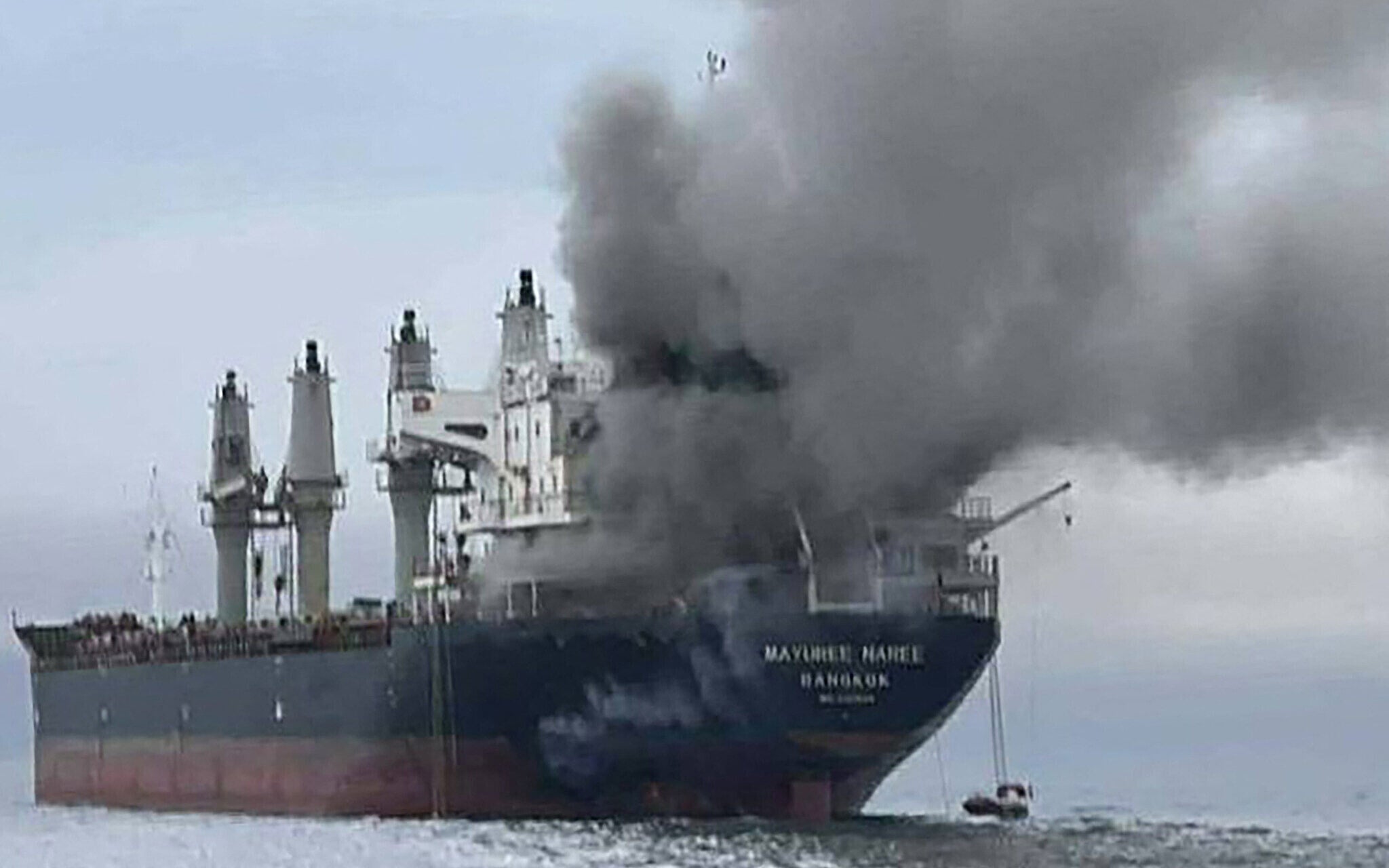
The United States is reportedly planning a weeks-long operation to force Iran to reopen the Strait of Hormuz, an Israeli report claimed Sunday, as Israeli and American officials continued to tout the potential fall of the Islamic Republic’s regime as a result of the escalating attacks.
Israel’s ambassador in the US, Yechiel Leiter, told CNN Sunday that the war must continue until the Islamic Republic’s regime is degraded to the extent that it has “no power” and the Iranian people can rise up and topple it.
“What we have to focus on now is degrading to the point where they have no power left in this regime. Hopefully, that will trigger this combustion point where the people are able to take charge of their own lives. Our focus has to be on degrading this regime to the point where they no longer pose a threat to us, to the region, to the world,” Leiter said.
The campaign would end, he contended, when “there is not an entity in Tehran that’s going to threaten the region.”
He said that such an outcome could come about by “this regime having a change of heart,” though he said that was “hard to imagine” and a popular uprising was more likely: “Probably, it’s going to take place because the Iranian people have had enough.”
“I think that we need boots on the ground, but they’ve got to be Iranian boots, and I think they’re coming,” he added. Asked to elaborate, he compared the situation to the collapse of the Soviet Union, and of Romania’s communist government, in the late 1980s.
The U.S. and Israel planned this operation together, we’re executing it together, and we will bring this terror regime to its knees – together. ????????????????
Watch my full interview with @DanaBashCNN ???????? pic.twitter.com/h2LcTjQxzU
— Ambassador Yechiel (Michael) Leiter (@yechielleiter) March 22, 2026
“There’s a point of combustion,” he said. “Look, nobody knew when the Soviet Union would collapse. Nobody knew when the Romanians would turn their guns against their… government. But it happened at some point. And if we degrade them enough, the people of Iran are going to say, we’ve had enough and we want a different regime.”
US President Donald Trump and Prime Minister Benjamin Netanyahu have both called for the Iranian people to rise up, following mass anti-regime protests there in January that were put down in a deadly crackdown.
Trump has also escalated his threats over Iran’s chokehold on the Strait of Hormuz, a critical oil shipping route, issuing a 48-hour ultimatum on Saturday night to open it, or the US would target Iranian power plants.
If Iran does not give in to that deadline, White House officials have told their Israeli counterparts that the war will be extended to make time for a planned US operation to reopen the waterway that is expected to take several weeks, Israel’s Channel 12 reported Sunday.
US officials have been telling the Israelis that a change in strategy is needed, and that Washington will not allow Iran to take the Strait of Hormuz, through which 20% of the world’s oil flows, hostage. “We will use this to make them collapse from within,” said US officials, according to the network.
Iran has contended that its civilian water and energy infrastructure have already suffered extensive damage due to what it claims are US and Israeli strikes on tens of thousands of civilian sites.
“The country’s vital water and electricity infrastructure has suffered heavy damage following terrorist and cyber attacks by the United States and the Zionist regime,” said energy minister Abbas Aliabadi, according to Iran’s ISNA news agency. “The attacks targeted dozens of water transmission and treatment facilities and destroyed parts of critical water supply networks,” he noted, adding that efforts were underway to repair the damage.
Iran’s Red Crescent chief Pirhossein Kolivand said the total number of damaged civilian sites “has reached 81,365 based on the latest field assessments.”
He said the figure includes residential and commercial units, schools, medical centers and vehicles.
Iran keeps firing cluster missiles
Iran fired a total of 10 missile salvos Sunday at central, northern and southern Israel, some of them dropping cluster munitions that impacted in the country’s center, injuring 15 in the afternoon.
More fragments impacted without causing injuries, and at least one missile was intercepted outside the atmosphere by the long-range Arrow 3 air defense system.
פיצוץ מחוץ לאטמוספירה: הטיל האיראני ששוגר לדרום יורט באמצעות מערכת חץ | צפו בתיעוד@VeredPelman pic.twitter.com/9lrvhVptUF
— כאן חדשות (@kann_news) March 22, 2026
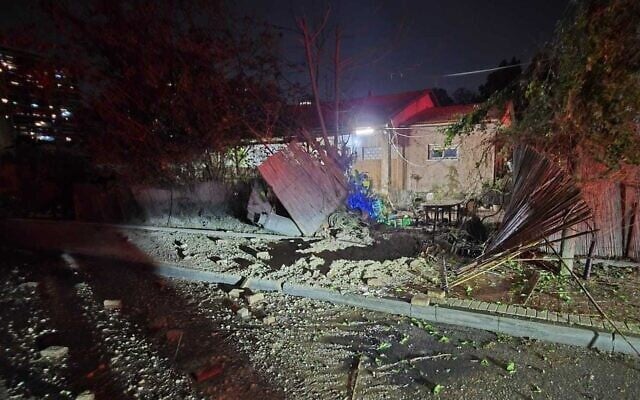
Immediately after midnight Sunday-Monday, another Iranian attack caused damage but no injuries in several impacts of cluster munitions or other falling fragments in central Israel.
One of the ballistic missiles launched by Iran at central Israel a short while ago carried a cluster bomb warhead, footage shows. pic.twitter.com/qHysDob1zX
— Emanuel (Mannie) Fabian (@manniefabian) March 22, 2026
One ballistic missile was assessed by the IDF to have struck Lebanese territory, the first time that an Iranian ballistic missile has hit Lebanon during the current war. It was unclear whether Iran had been aiming for Israeli troops operating in southern Lebanon or for a target in Israel.
More than 400 ballistic missiles have been launched from Iran at Israel since the start of the war, with the military reporting an interception rate of 92 percent of attacks heading for populated areas and key infrastructure.
In all, five missiles carrying conventional warheads with hundreds of kilograms of explosives have struck populated areas in Israel, causing extensive damage in four cases. There have also been more than two dozen incidents of missiles carrying cluster bomb warheads hitting populated areas, with over 100 separate impact sites.
The IDF said in the early morning hours of Monday that it had launched a “wide-scale” wave of airstrikes in Tehran, targeting infrastructure of Iran’s “terror regime,” without elaborating.
On Sunday, the army said that it had struck Tehran the previous night as well, hitting several Iranian weapon production sites and various headquarters of the regime.
According to the military, the targets hit by Israeli Air Force fighter jets included an Iranian army training base that included a storage site for anti-aircraft missiles; a weapons production and storage site of the Iranian defense ministry; a weapons production site of the IRGC air force; a headquarters of the Iranian intelligence ministry; and a headquarters of Khatam-al Anbiya, Iran’s military emergency command.
The IAF fighter jets dropped dozens of bombs on the sites, the military said, describing the strikes as part of a “phase of deepening the damage to the core systems of the Iranian terror regime and its foundations.”
In total, the IAF has conducted hundreds of waves of strikes in Iran, dropping over 13,000 bombs on Iranian regime and military sites, including air defense systems, ballistic missile launchers, weapon production sites, nuclear facilities and various headquarters.
The IDF has estimated that some 5,000 Iranian soldiers have been killed in Israeli strikes, along with tens of thousands more wounded, many of them members of the internal security forces and Basij paramilitary force.
Israel launched its campaign against Iran, alongside the US, to degrade the Iranian regime’s military capabilities, distance threats posed by Iran — including its nuclear and ballistic missile programs — and “create the conditions” for the Iranian people to topple the regime, the military and other Israeli leaders have said.
Since the war began on February 28, 15 Israeli civilians and foreign nationals have been killed in Israel in Iranian ballistic missile attacks, along with four Palestinians in the West Bank.
